
To choose the right flute laminator, match five things to your production: sheet size range, throughput in sheets per hour, the board and face-paper you laminate, the automation level you need, and the laminating accuracy your finished boxes demand. Get those five right and the machine fits your line; chase a headline speed figure alone and you risk buying capacity you can't feed. This guide explains each factor and compares BMC's servo laminator models using their real specifications.
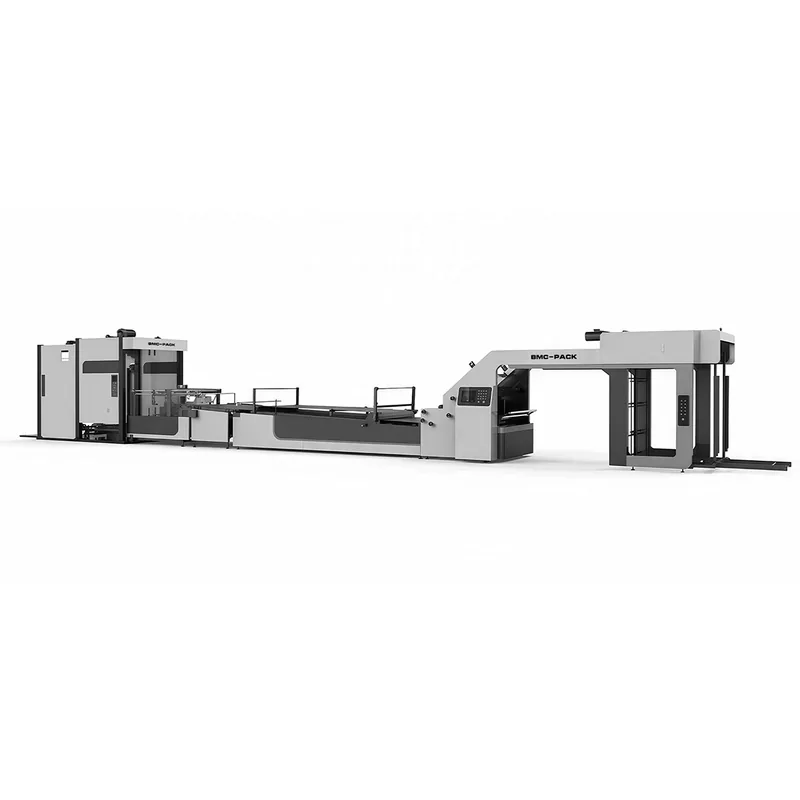
What a flute laminator does
A flute laminator bonds a printed top (face) sheet onto a corrugated board so you get the print quality of litho or flexo-printed paper with the strength of corrugated — the standard construction for premium retail boxes, shelf-ready packaging and displays. The face sheet is glued and pressed onto the flute board in accurate register; the quality of that register and the flatness of the bond are what separate a good laminator from a frustrating one.
The five factors that decide the right laminator
1. Sheet size range
List your largest and smallest sheets. Confirm both fit between the machine's maximum and minimum sizes — an oversized machine wastes floor space and glue, an undersized one caps your box range.
2. Throughput
Rate the machine in sheets per hour against your real order volume, and remember sustained working output is what matters, not just the peak figure.
3. Board and face-paper range
Check the flute profiles (A, B, C, E, F), maximum board thickness, and face-paper weight range against what you actually run.
4. Automation level
Fully automatic servo feeding suits continuous, high-volume work; semi-automatic models suit lower volumes or a wider job mix at lower cost.
5. Laminating accuracy
Tighter registration matters most for high-value printed boxes. Confirm the rated accuracy on both corrugated and paper-to-paper work.
Compare BMC flute laminators
These are published specifications for three BMC servo laminators, so you can see how the factors above map to real machines:
| Specification | A Type Servo Automatic | High-Speed Servo | 5-Ply 3-in-1 Automatic |
|---|---|---|---|
| Model example | BMC-1300FA3 / 1600FA3 | BMCVT-1450HFA3 / 1650HFA3 | BMC-1300FA5 / 1450 / 1600 |
| Max. speed | 8,000 pcs/h (5,000 m/h) | 12,000 pcs/h (9,000 m/h) | 4,000–6,000 pcs/h |
| Laminating accuracy | ±1 mm | Corrugated ±1 mm (±0.5 mm); paper ±0.5 mm | ±1.5 mm |
| Max. sheet size | 1300 / 1600 × 1250 mm | 1450 × 1250 / 1650 × 1450 mm | 1300 / 1450 / 1600 × 1200 mm |
| Min. sheet size | 400 × 400 mm | 400 × 400 mm | 550 × 550 mm |
| Face paper | 130–800 g | 130–800 g/m² | 140–600 g/m² |
| Bottom board | 2/4-ply A/B/C/E/F flute | Corrugated 0.5–10 mm (B,A,AB,E); paper >350 g | A,B,C,E,F ≤ 10 mm |
| Power | 14 kW | 20–22 kW | 20–22 kW |
See each machine in detail: the A Type servo automatic laminator, the high-speed servo laminator, and the 5-ply 3-in-1 automatic laminator, or browse the complete flute lamination machine range.
Matching the machine to your line
If you run long, repeat orders of printed retail boxes, the high-speed servo model gives you the throughput and the tightest registration. For mixed medium-volume work, the A Type servo automatic balances speed and cost. If you laminate heavier 5-ply constructions, the 5-ply 3-in-1 automatic laminator is built for that job. Many plants report that servo drive — replacing chain-and-gear transmission — noticeably reduces misalignment scrap and keeps registration stable across the full speed range, though the exact benefit depends on board grade and glue.
Buyer checklist
- Confirm largest and smallest sheets fit the min/max sizes.
- Rate throughput against sustained volume, not just peak speed.
- Verify flute profiles, board thickness and face-paper weight.
- Choose automatic vs. semi-automatic by volume and job mix.
- Check laminating accuracy on both corrugated and paper work.
- Confirm installation, operator training and after-sales support.
Summary
A flute laminator is the right choice when you need printed-paper quality with corrugated strength. Pick it by sheet size, throughput, board range, automation level and accuracy — in that order — rather than by top speed alone. BMC's servo laminator range covers medium-volume to high-speed production; once the laminated board is ready it feeds naturally into die-cutting and creasing and finishing. Tell our engineers your sheet sizes and volumes and we'll match the model to your line.