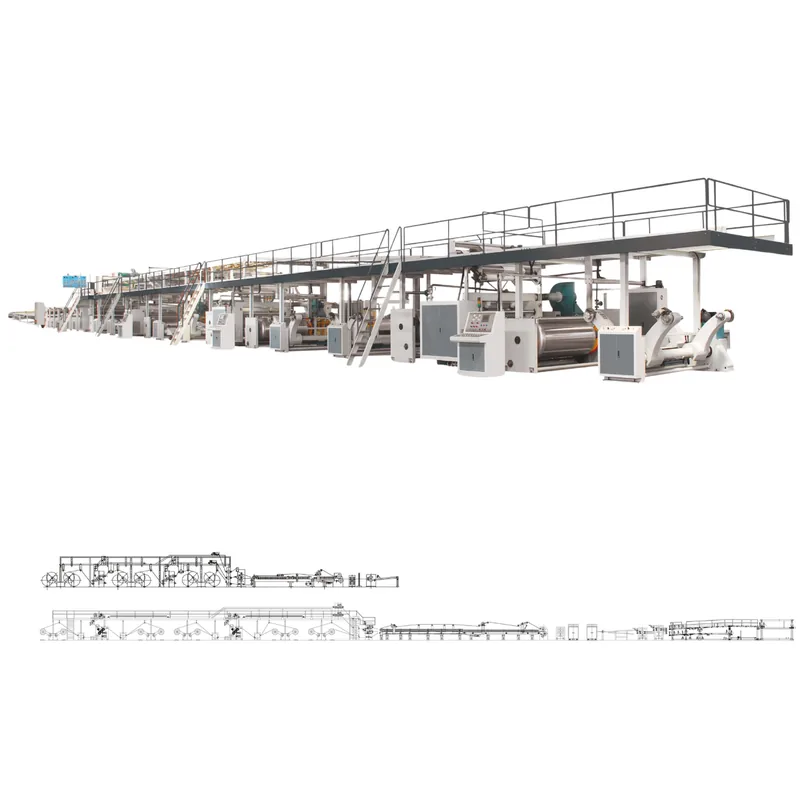
Corrugated cardboard is made by fluting a paper medium into waves, gluing it between flat liner sheets, then cutting, printing and converting the board into boxes. In order, the steps are: prepare paper, form the flute and bond one liner (single facer), bond the outer liner under heat (double facer), cut to size, then print, die-cut and folder-glue. Each step is a dedicated machine on a continuous line. Here's how the whole process fits together.
1. Raw materials and conditioning
The board starts as reels of kraft liner (the flat outer papers) and corrugating medium (the paper that becomes the flute). Paper is preheated and conditioned so its moisture is in the right range for gluing — too dry or too damp and the bond suffers.
2. Single facing: forming the flute
The single facer passes the medium between heated corrugating rollers to form the flutes, applies starch-based adhesive to the flute tips, and bonds one liner to make a single-faced web. Flute profile (A, B, C, E…) is set here.
3. Double facing: bonding the outer liner
The double facer glues the second (outer) liner and carries the board across heated plates under even pressure, setting the adhesive and flattening the board. This is what produces flat, strong, print-ready board — and where 5-ply and 7-ply constructions are built up.
4. Cutting and stacking
A slitter-scorer and cut-off knives trim the continuous board to width and length and score it, and automatic stackers collect the sheets — all synchronised to line speed.
5. Printing, slotting and die-cutting
Sheets move to a flexo printer, where anilox rollers meter water-based ink onto the board; combined machines then slot and die-cut the blank in the same pass.
6. Folding and gluing
Finally a folder gluer folds the printed, cut blank and joins the manufacturer's seam (by gluing or stitching) to produce a finished, flat-packed box ready to ship.
Quality and control
Throughout, a central PLC and servo drives keep glue, heat, tension and registration consistent; finished board is checked with tests such as Edge Crush (ECT) and bursting strength. Modern lines run at high continuous speed — BMC's advanced 3/5/7-ply line reaches working speeds up to 180 m/min — which is why consistency at each step matters so much.
Summary
Corrugated cardboard is made in a sequence — condition paper, single-face, double-face, cut, print/die-cut, fold-glue — each handled by a purpose-built machine on a continuous line. To see the machines behind each step, explore BMC's corrugated production line range, or read the history of corrugated cardboard for how it all began.